
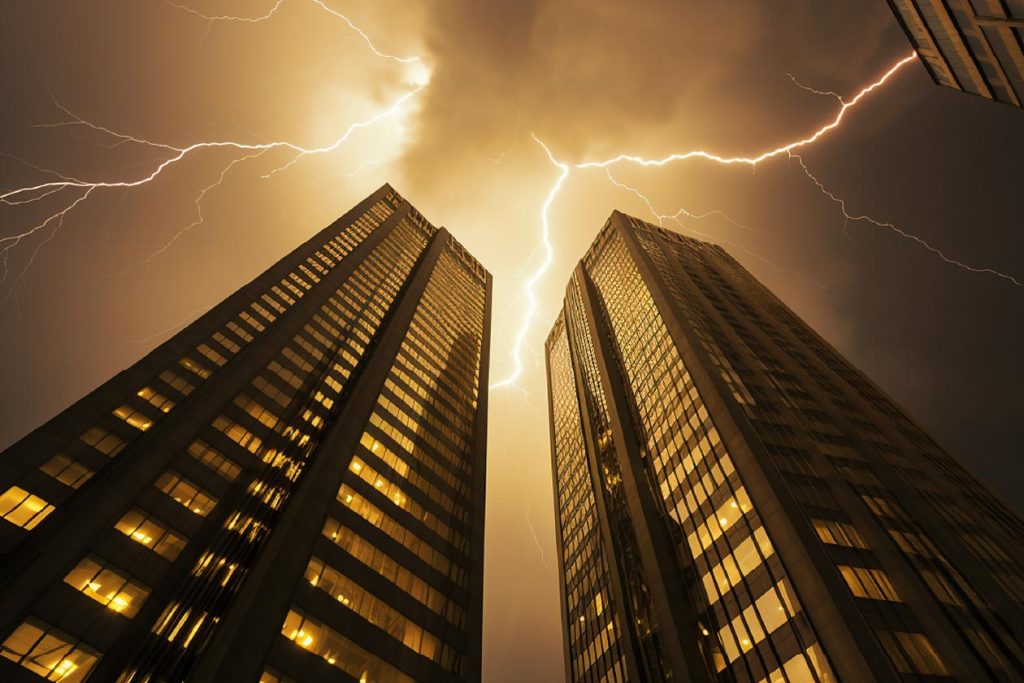
For modern production infrastructure, operational continuity is not merely a goal but the fundamental pillar underpinning corporate profitability. Interconnected production lines, enterprise servers, and large-scale on-site power generation systems rely on a perfect electrical balance to function.
In this context, a thunderstorm lasting just a few minutes or a sudden surge caused by atmospheric conditions can bring workflows to an immediate halt. Today, the true economic damage stems not from structural damage to the building itself, but from downtime—hours or days of unplanned production stoppages while waiting to restore sensitive, damaged electronic components.
1. The cost of downtime in the Industry 4.0 era
The advent of automation and industrial digitalization has concentrated corporate value within microprocessors. While this has optimized performance and efficiency, it has also left companies highly vulnerable to electrical issues. A voltage surge caused by lightning—even if the strike occurs at a distance from the facility—can propagate through data and power lines, bringing operations to a complete standstill.
2. Why is limiting oneself to managing the effects of the discharge an operational risk?
What distinguishes the protection systems available on the market?
When faced with the threat of lightning strikes, most systems address the issue by focusing solely on the phenomenon’s effects. Some devices are designed to attract the electrical discharge to the structure and then attempt to channel and dissipate it into the sea; other technologies seek to balance the electrostatic field using a capacitor, aiming to inhibit the phenomenon’s formation within the protected area.
However, channeling or managing millions of volts near an industrial facility or a smart home still exposes sensitive microprocessors to devastating electromagnetic shocks. Merely containing or partially reducing the intensity of a discharge after it has already occurred does not guarantee the safety of state-of-the-art integrated circuits, leaving the business vulnerable to financial losses and hidden damage.
3. Which facilities and structures are the most vulnerable?
Which corporate assets suffer the most damage from overvoltage?
Many assume that lightning strikes only isolated towers. In reality, large, low-profile logistics facilities are highly vulnerable targets due to their geographic exposure, surface area, and conductive materials.
The absence of upstream preventive protection—acting before the surge event occurs—systematically impacts a company’s most expensive and strategic technologies:
- Photovoltaic inverters and surge protection: Voltage spikes destroy inverter circuit boards, halting renewable energy production and necessitating lengthy, costly replacements.
- PLCs and automation lines: The microprocessors controlling industrial robots and assembly lines lock up or suffer hardware failure, abruptly interrupting the production workflow.
- Server rooms and Smart Offices: Data storage systems and core network infrastructure experience blackouts or critical data loss, cutting the company off from the market.
4. Elimination of risk: scientific stability for over 70 years
How can true business continuity be ensured? Ultimate protection is achieved only by anticipating the threat. The comprehensive Euthalia system employs Antimpatto® technology to act directly on the electromagnetic field, completely neutralizing the formation of lightning and associated surges at the source, thereby preventing the phenomenon from occurring within the protected area.
For safety managers seeking a definitive lightning prevention solution for industrial facilities, reliability is proven by results. Euthalia offers a patented technology that has successfully withstood every test for over 70 years, delivering long-term stability and comprehensive, unrestricted protection.
Integrating Euthalia into project specifications means choosing to eliminate critical risks entirely, safeguarding the value of technology investments and ensuring operational efficiency over time.
Do you want to stop having to shut down production every time there’s a thunderstorm? Secure your business and your work today.
Find out who needs to conduct the assessment and how to truly protect what matters.

