
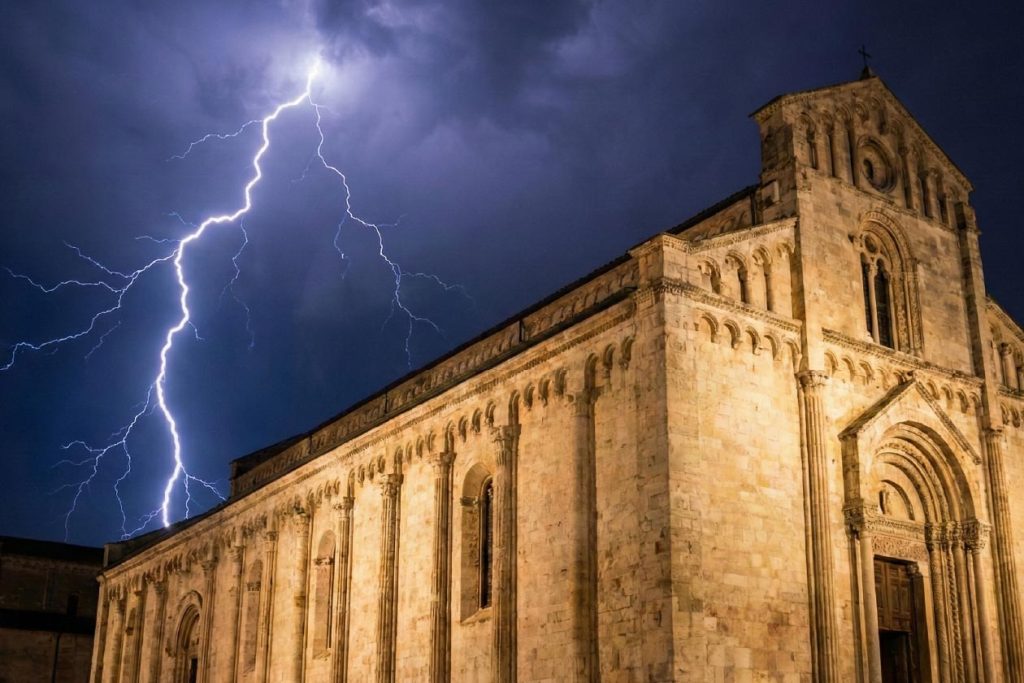
Protecting cultural heritage from lightning strikes no longer means covering it with copper or visible nets. There are solutions that focus on prevention, i.e. preventing the discharge from forming with minimal aesthetic impact.
When it comes to protecting our historical and artistic heritage, the challenge is twofold: ensuring maximum safety from atmospheric discharges while preserving the aesthetic integrity of the monument.
⚡ Why traditional systems create an aesthetic compromise
Traditional technologies (the classic Faraday cage or ESE systems) often impose unacceptable compromises. Exposed copper cables, metal mesh enveloping centuries-old façades and sensors towering over domes and bell towers. In a word: invasiveness.
The dilemma facing the Superintendency: safety or aesthetics?
Until yesterday, architects and restorers were faced with a difficult choice: risk devastating damage from lightning or alter the architectural harmony of the building with systems that “attract” the discharge and then disperse it to the ground.
How can you protect a historic building from lightning strikes without damaging the façade? On old buildings, ‘attracting’ lightning strikes can cause significant collateral damage: mechanical and thermal shock, fire risk (especially with wooden structures) and power surges that compromise internal systems and installations.
The collateral risks when ‘attracting’ the discharge to a fragile structure
Attracting lightning to an old building, often lacking reinforced concrete and rich in fragile or flammable materials (such as wooden roof beams), entails enormous collateral risks:
- Mechanical damage from impact.
- Fires triggered by high temperatures.
- Power surges that can damage lighting, audio and security systems.
And that’s not all: the interior of the building can also suffer serious damage, putting works of art, historic furnishings, organs and systems (alarms, lighting, video surveillance) at risk.
Why can ‘attracting’ lightning be risky on old buildings? Because even with perfect grounding, lightning generates an electromagnetic pulse (LEMP) so powerful that it can damage audio equipment, alarm systems or lighting without the current actually ‘passing’ directly through the systems.
The invisible revolution: prevention rather than attraction
The invisible revolution: the Euthalia Antimpact® System changes the rules of the game with technology that works preventively. Unlike traditional sensors, the Antimpact® System does not attract lightning. On the contrary, it works to inhibit the formation of lightning.
By creating a dielectric barrier, the system isolates the building from the atmospheric electric field, ensuring that lightning does not “see” the structure as a preferred discharge point.
Why it is ideal for Cultural Heritage
Total discretion: the system has minimal dimensions and does not require the imposing networks of cables typical of Faraday cages. The aesthetics of the monument remain intact.
No mechanical stress: by not attracting the discharge, the building does not suffer the thermal and mechanical shock of the passage of current. Protection of interiors: by avoiding impact, the risk of power surges that could damage audio systems, alarm systems or lighting is drastically reduced.
Discover how protection for churches, bell towers and historic buildings works with Antimpatto® technology
Discover the lightning conductor for churches and historic buildings
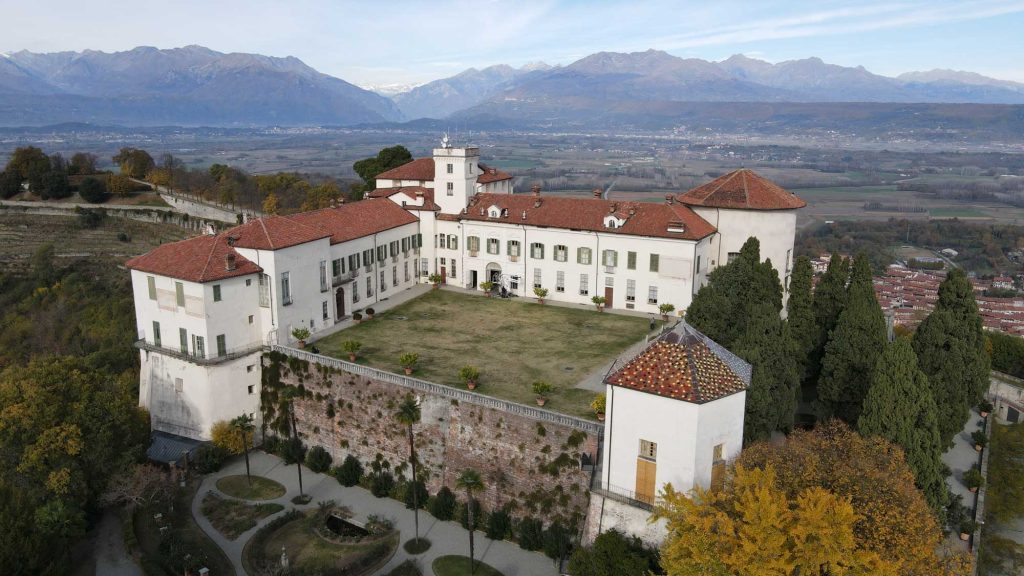
Case study: Masino Castle (Caravino, Turin)
A prime example of this application is Masino Castle (Caravino, Turin), a property protected by the FAI. Located on an isolated hill and rich in underground water, the castle was historically subject to frequent lightning strikes. The need was to protect the structure and its systems without altering the beauty of this thousand-year-old residence. Thanks to Euthalia technology, installed in 2022, it was possible to guarantee total protection from direct and indirect lightning strikes while maintaining zero architectural impact, thus preserving the magic of the place intact.
Protecting history no longer means caging it. With Euthalia, safety becomes an integral but invisible part of the architecture.
Do you want to protect a historic building without altering its façade?
Find out who should do the assessment and how to truly protect what matters
FAQ — Lightning protection for historic buildings and churches
Is a Faraday cage always suitable for cultural heritage?
Not always. It is effective, but it can be invasive (visible drops and meshes) and in restricted contexts the aesthetic impact may be incompatible with conservation and restoration.
What is the difference between traditional systems and a preventive approach?
Traditional systems manage the discharge when it arrives (capturing and dispersing it to the ground). A preventive approach, on the other hand, aims to eliminate the probability of lightning striking the structure, also limiting side effects.
Is it possible to protect a church without exposed copper downpipes?
Yes, in many cases it is possible to design protection with minimal architectural impact, avoiding conspicuous nets and cables and complying with aesthetic constraints.
How can power surges and damage to internal systems be reduced?
With a coordinated project that includes surge protection and proper management of electrical circuits, thereby reducing the risk to lighting, alarms and technological systems.
Does a wooden roof increase the risk in the event of a lightning strike?
Yes. Combustible materials and fragile historic structures can be more vulnerable to ignition and thermal damage, which is why prevention is key and not “discharging”.
What documentation is usually required for a meeting with the Superintendency?
As a rule: technical report with proposed solution, reasons for compatibility with the property, drawings/layouts, description of visual impact, applicable regulatory references and (if available) examples/case studies in similar contexts.

